
Disclosure – this is a collaborative post.
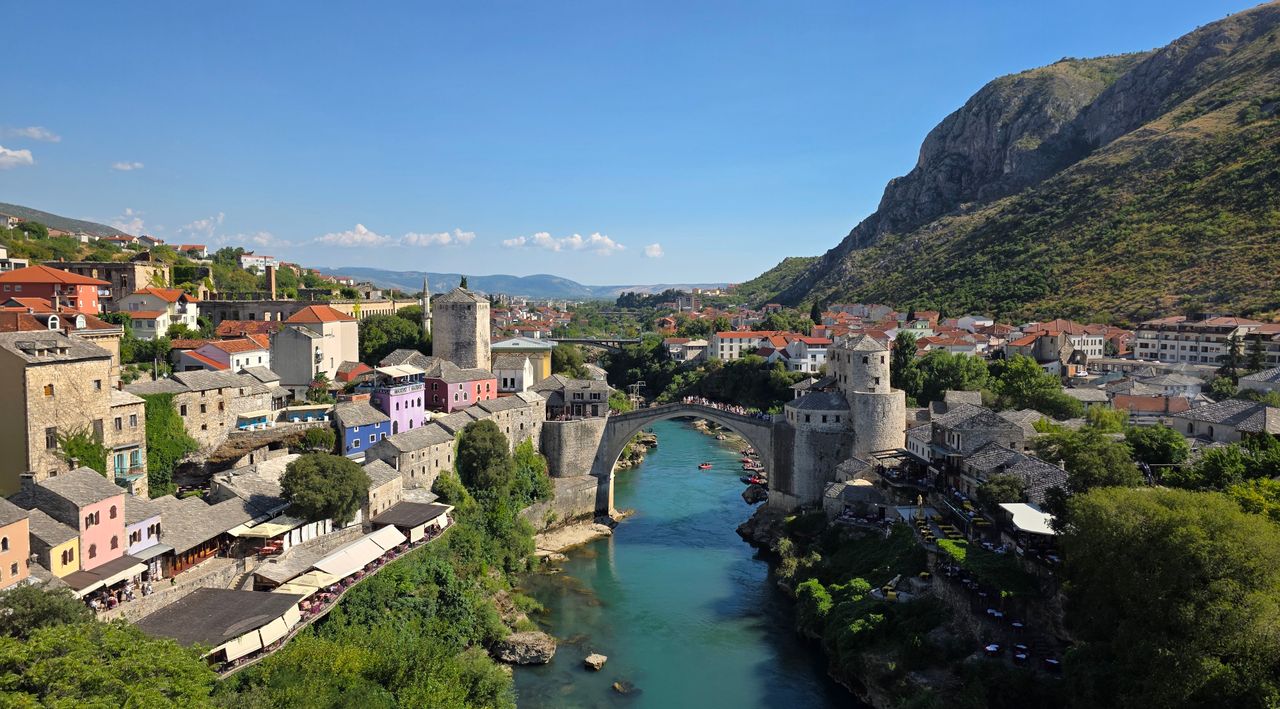
We came into Mostar on a Sunday in the second week of November, in rain that had been falling since Jablanica and showed no intention of stopping. The Neretva was up and had gone the colour it turns in bad light—not the postcard green, something nearer slate with green somewhere underneath. We had meant to do this leg in August and moved it twice. By the time we actually stood on Stari Most, there were four other people on it, and two of those were locals crossing to get somewhere.
That is the trade. Come in November and the most photographed stone in the country is yours for as long as you care to stand on it. Come in November and you also find that a good deal of the town has quietly shut for the year.
The Bridge Without the Queue
The bridge earns the attention it gets in July, which is exactly why it is worth seeing when nobody is giving it any. Mimar Hayruddin built it for Suleiman the Magnificent, the arch opened in 1566, and it stood four centuries before Bosnian Croat forces shelled it down on 9 November 1993. It was rebuilt between 2001 and July 2004, and UNESCO listed the old city the year after.
What is different in the wet is the deck itself: the limestone goes slick as soap, and the raised ridges cut across it stop being a quaint detail and become the only reason you stay upright.
The divers were gone. The club jumps the 24 metres into the river from roughly May through October, and outside that they appear only on a freakishly warm afternoon, and only if enough people gather to make a collection worth taking. In November, the board on the parapet is a bare plank with rain standing on it. We knew this before we booked and still felt the absence. Without a diver on it, the bridge is a beautiful object rather than an event.
The closure we had not budgeted for was the museum in the Tara Tower, which runs from the first of April to the first of November and had shut nine days before we arrived. That one stung.
We climbed the minaret of the Koski Mehmed Pasha Mosque instead, built in 1618 and open until four in winter, up steps narrow enough that two people cannot pass without one of them apologising. From the balcony, the bridge sits in its gorge with the town folded around it, roofs dark and running with water, and nobody behind us on the stair to hurry for.
Getting Anywhere From Here
The off-season makes you think about transport in a way August never does. Our flight home went from Split, and November is when the timetables begin quietly saying no—the morning coach still runs, but the connections thin out, the daylight is short, and neither of us wanted to spend our last hours in the country watching a bus-station clock.
We looked at hiring a car and dropping it across a border, priced that, and thought better of it. What we settled on was a driver for the last stretch from Mostar to Split—about 160 kilometres, under three hours, one border post—and the same arrangement bought us a day out to the villages south of the city, which turned out to be the better half of the decision.
Blagaj is fifteen minutes away. The tekke was raised around 1520 for dervishes of the Bektashi and later the Halveti orders, and it stands with its back to a limestone wall two hundred metres high, where the Buna comes straight out of a cave at some 43,000 litres a second, seven to nine degrees, every day of the year.
In summer, the terrace restaurants compete with the river for the noise. In November, the river wins outright. The house was open, nine until five, and for half an hour we had the wooden rooms and the low windows to ourselves.
Počitelj was emptier again. The Ottoman town climbs the hillside above the Neretva on stone steps, fort at the top, clock tower below, the mosque destroyed in 1993 and since put back. In season, there are women selling pomegranates and dried figs on every landing; we counted two, both under umbrellas, both entirely patient with us.
Kravice was the surprise. From November to March, the falls cost nothing to enter, a fair exchange for what you give up: swimming is finished, the water sits at eight to ten degrees, and almost everything at the bottom is padlocked.
What is left is a hundred-metre curve of travertine with 25 metres of water coming off it, louder in autumn than we expected, and we walked the basin without meeting another soul.
We left on the Thursday. The car we had arranged through Balkan Chauffeur was outside at eight in the dark, and we were glad of it—glad not to be hauling wet bags to a bus. The road lifts out of the valley into bare limestone, drops past Vrgorac, and the light changes the way it only does near the Adriatic.
The border took eleven minutes. By late morning, we were at the airport out at Kaštela with salt in the air, a strange thing to walk into after four days of river.
Why November Suits It
You lose real things by coming late: the divers, the tower museum, the terraces along the Buna, the long evenings, the green the Neretva only shows under a high sun. We would not pretend otherwise.
What you get back is the town at its own pace—coppersmiths working rather than selling, half the bazaar shuttered and the other half in no hurry, and a bridge you can stand in the middle of for ten minutes without stepping aside for anyone.
The rain is not incidental to that. It is the reason. Four days of it, then a morning on the coast with a boarding pass, still reluctant to be going.
One Last Look
Mostar in November asks for a little more patience. The weather turns, the divers disappear, opening hours shorten, and the town gives up some of what makes it easy in summer. But what remains feels less arranged for visitors and more like a place continuing without them.
We came for the bridge and ended up remembering the river, the empty roads to Blagaj and Počitelj, the sound of Kravice without swimmers, and the strange relief of having nowhere to stand in a queue.
By the time we left, the rain had stopped. Mostar was still grey, the Neretva still running high, and Stari Most still spanning the gorge exactly as it had when we arrived. We crossed it once more, alone except for a local heading the other way, and then went south towards the coast.
Disclosure – this is a collaborative post.

